
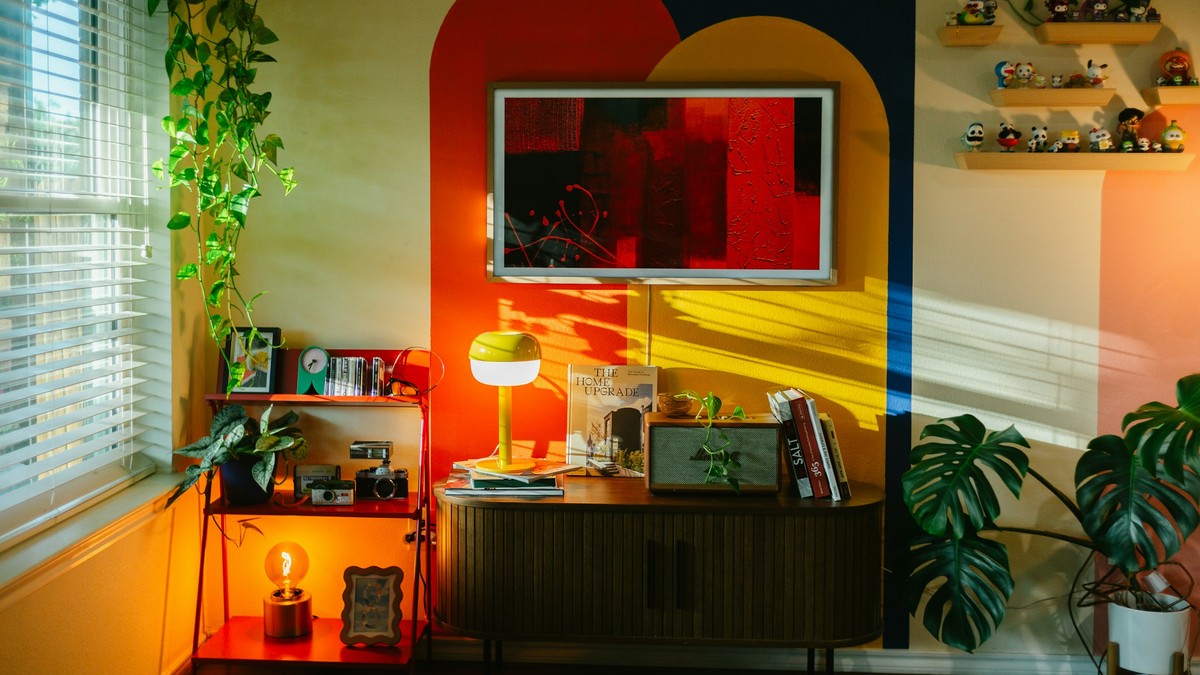
Abstract art has one advantage over every other kind of wall art: it does not need to be recognised. A room does not have to be about music, film, or sport to carry it. The only questions are colour, scale, and how the piece behaves against the wall behind it.
Working out what the wall needs
Before choosing a piece, decide what the room is missing. A neutral room usually needs one strong colour. A busy room needs something calmer. A room that already has a lot of pattern needs a piece with a clear, simple structure rather than more texture.
That decision narrows the choice more than taste does, and it prevents the common mistake of buying a print that is beautiful on its own and wrong in the room.
Styles and their effects
- Geometric compositions: orderly, architectural, suit modern furniture.
- Organic and painterly forms: softer, warmer, suit older interiors.
- Monochromatic pieces: quiet and flexible, easy to group.
- High-saturation colour fields: a single bold statement on an empty wall.
Scale is the whole decision
Abstract art is very sensitive to size. On a large empty wall a small abstract piece looks like a stamp, regardless of how good it is. The usual guidance is to place a piece that occupies roughly two thirds to three quarters of the width of the furniture below it, and to leave generous space above and to the sides.
Oversized abstract art is a legitimate choice in a minimalist room, but it works only if the wall is genuinely empty around it.
Framing choices
Two approaches dominate. A thin, nearly invisible frame lets the colour reach the edge and feels contemporary. A wide, plain mount inside a simple frame makes even a small piece feel deliberate and is more forgiving in a traditional room. Canvas-style presentations suit painterly work and avoid reflection entirely.
Where the room is bright, choose a matte surface or non-reflective glazing. Gloss under a downlight turns an abstract print into a mirror.
Placement and lighting
Abstract art does well above furniture that is lower than it, such as a sofa or sideboard, and above desks. It works less well in corridors, where people see it at an angle and in passing, unless the composition is very simple.
Uneven lighting shows more on large flat colour fields than on detailed images, so check the wall at different times of day before committing to a final position.
Care
Keep prints out of direct sun, frame with an acid-free mount, and dust with a dry cloth. Flat colour is unforgiving: a single crease or surface mark that would vanish into a busy photograph will be obvious on a plain field of colour, so handle these pieces more carefully than any other.
Common mistakes
Abstract art fails on a wall in three predictable ways. It is hung too small for the space. It is hung too high, usually leaving a gap of empty wall between the artwork and the furniture it should be related to. And it is framed in a highly decorative style that contradicts the simplicity of the image.
All three are corrected by the same habit: hang the piece in relation to the furniture below it, keep the centre line at a comfortable viewing height, and keep the frame nearly invisible unless the room itself is traditional.
Living with one large piece
A single large abstract piece is one of the easiest ways to finish a room, because it removes the need for a gallery wall. The requirement is genuinely empty wall space around it. If the wall is covered in shelves, plants, or smaller pictures, the large piece will simply be absorbed into the clutter and lose the calm that made it attractive.
The value of abstract art on a wall is that it asks nothing in return. It sets the tone of a room without adding a story, and that leaves the rest of the space free.